

本站推荐电影
-
·2026年海峡两岸(福建)书院文化交流活动在厦启动
·जैतपुर थाने में पुलिस हिरासत में किशोरी ने की आत्महत्या की कोशिश, शौचालय जाने के बहाने निगला जहर
·【第610期·“育”见成长】蛇年绘新篇 童心扬帆航——长沙县百熙教育集团荣盛花语城幼儿园开学第一天纪实
·2026温州市福彩代销者(销售员)技能比武大赛圆满落幕
·地方国资“落子”公募股权,行业棋局悄然重构
·宗乡总会举办活动 展示我国戏曲文化
·跳水世青赛:中国队获混合团体冠军
·Going Downhill: Record Low 38% of US Adults 'Extremely Proud' to Be American, Poll Finds
·县税务局开展消防安全知识培训活动
·强台风“沙德尔”逼近浙闽沿海 福州各部门迅速响应积极应对
·《寂静岭》新作预告公开 巨型怪物现身迷雾!
·春雪食品:公司2026年1-6月份计提信用减值损失274.11万元
·中国印尼全面战略对话机制举行首次会议
·【教师加油站】探索科学奥秘,奏响艺术乐章—西安未央悦墅幼儿园教师公开课观摩活动
·擘画上合发展蓝图 共促地区繁荣稳定_合作_习近平
本站推荐电视剧
-
·Xishuangbanna holds event to mark World Elephant Day(1/4)
·UNESCO chief reaffirms support for Lebanon, announces assistance
·“水源严重污染,鱼类漂浮成灾”?青岛警方:造谣者被刑拘
·内蒙古满洲里:常态化区域核酸检测中筛出1管混采阳性,对全域实施从严管理_疫情_防控
·小柿子满架 种植户开心
·兴城:“党建联盟”结对共建 激发党建新活力
·前国乒选手报警,回应录音争议:不是说王楚钦
·'पटेल 14 वोट लेकर हारे तो नेहरू एक वोट लेकर जीते... ये थी असली बूथ कैप्चरिंग', कांग्रेस के आरोपों पर CM सैनी का पलटवार
·河南队主帅南基一累计两黄,下一轮对阵国安将停赛
·苏州夺冠归来,邯郸小将观战五超:长大后,我要为家乡而战!
·带孩子去游乐场,第一次玩儿童钢架低空滑索?这些技巧帮你轻松应对
·福建雷雨天气频繁“打卡” 闷热继续在线
·富春江南岸1800℃的“炼丹炉” 炼出了全球最大的氧化镓单晶
·Janet Jackson's 1989 Hit 'Rhythm Nation' May Literally Crash Laptops, Microsoft Says
·国际消除对妇女的暴力日 | 消除暴力,为爱护航!
电影下载排行
-
·省级“无废细胞”建设典型案例公布 福州3家单位入选
·Microsoft Online Try.net,支持在浏览器中运行C代码
·库里38岁仍断档第1!美媒评新赛季联盟30大射手:谢泼德15克莱19
·NBA调查将为快船洗清嫌疑 让爆料记者付出代价
·优地机器人通过港交所上市聆讯
·'Not Putin Who Raised Taxes': Swedish Opposition Leader Blasts Gov't for Scapegoating Russia
·奥克兰高峰时段发生激烈追逐:逃逸车辆逆行险象环生,两人被捕
·多个城市推出“五一定制套餐” 这份攻略请查收
·雷霆狂胜灰熊51分 分差排名季后赛历史第5位 前6名都是谁?
·哈空调:上半年亏损5253.81万元
·黄金面临重要阻力,杰克逊霍尔会议或将成为关键指引
·Stein:科沃尔工作4年后与老鹰友好协商离任
·浙BA杭州赛区决赛今晚开打,谁将问鼎“杭州王”?
·Xi holds talks with Jordan's king; visit empowers development co-op to serve as a pillar of regional stability: expert
·凌晨美股全线拉升!特朗普重磅发声
电视剧下载排行
-
·雷军点赞特斯拉!没有驾驶员的Model Y自己从工厂交付到用户手中
·南平市延平区“闲地焕新” 破题老城停车难
·Shabana Azmi Joins The Cast of Awarapan 2
·大唐四川发电有限公司原巡视员段忠民接受审查调查
·小米海外预热Poco M8 Power 5G手机,疑为REDMI Note 17换标版本
·为什么AI还不会科学发现?这是人工智能的终极考题
·国际空间站掉下来的垃圾,把人家房子砸了个窟窿?!
·10股筹码连续多期集中!下周2股解禁比例超50%(附股)
·武警部队“英雄路·新长征”活动在四川雅安举行
·香迷糊了!中省直媒体聚焦,抚顺麻辣拌出圈!
·5100万引进!官方:31岁拜仁中场帕利尼亚加盟本菲卡,总价1900万
·GPT-5.6-Sol在网络攻防能力上,超越了Mythos!开源模型也排好了
·广东信宜:文明生沃野 心田沐新风
·暴雨+强对流双预警齐发 部分地区将有10级以上雷暴大风
·华安基金:创业板50指数聚焦四大新质生产力赛道
3c认证
-
发布时间:2026-08-26
汉尼拔
Third China-US Track 1.5 Dialogue held in Beijing as attendees discuss constructive strategic stability, practical cooperation_我的网站

A |

The assessment showed that the nine islands and reefs are generally in good ecological condition, although their ecosystems vary significantly from one location to another. The findings are expected to provide a scientific basis for more targeted conservation and management of different types of island and reef ecosystems.
Coral reef ecosystems in the Xisha Qundao have shown encouraging signs of recovery. The overall ecological conditions of four atolls, including the Beijiao, the Yongle Atoll, Yuzhuo Jiao and Langhua Jiao, of the Xisha Qundao, were rated as good.
Although live coral cover remains relatively low as a result of the large-scale coral bleaching event in 2020 and outbreaks of crown-of-thorns starfish since 2018, the reefs have recorded a high level of hard-coral recruitment, indicating strong and continued recovery, CCTV reported.
Coral reefs are one of the best natural indicators of seawater quality, and are also a key foundation for marine biodiversity, Chen Xiangmiao, director of the World Navy Research Center at the National Institute for South China Sea Studies, told the Global Times on Friday.
Huangyan Dao, meanwhile, stands out as a rare "biological gene bank" in the central South China Sea. Surveys recorded 135 species of reef-building corals around Huangyan Dao. Seagrass beds covering about 1.85 square kilometers were found distributed across its lagoon, with an average coverage of 19.2 percent. Live coral cover within the protected area has reached 38.8 percent.
The waters are also home to a range of rare and protected species, including green sea turtles, hawksbill turtles, giant clams and trumpet tritons, according to the assessment.
Chen said Huangyan Dao's coral reef ecosystem provides stable and diverse habitats for a wide range of marine species. With relatively limited development, its coral reefs function much like an underwater forest, offering feeding, shelter and breeding grounds for rare species such as sea turtles and giant clams. Its shallow lagoon and seagrass beds further enrich the variety of habitats, allowing different species to coexist and supporting a high level of biodiversity.
Ecological conditions among the Nansha Islands and reefs showed greater differences. While the overall condition remained good, some individual reef ecosystems have suffered serious degradation, according to CCTV News.
Xianbin Jiao and Niu'e Jiao were assessed as being in good ecological condition, with live coral coverage reaching 24.7 percent and 37.7 percent, respectively.
By contrast, the ecosystems of Tiexian Jiao and Ren'ai Jiao have deteriorated significantly.
At Tiexian Jiao, outbreaks of crown-of-thorns starfish, tropical cyclones and foreign human activities, particularly continued construction by the Philippines on Zhongye Dao, have contributed to ecological damage. The area covered by live corals has fallen by nearly 70 percent compared with 2016.
At Ren'ai Jiao, the long-term presence of a foreign military vessel illegally grounded there has caused pollution discharge, waste accumulation and fishing-net entanglement, according to the assessment. Live coral coverage has declined sharply, while both coral growth and natural recovery have been inhibited, according to CCTV.
China has also continued to increase investment in marine ecological conservation and restoration in the South China Sea.
According to one of the released reports on ecological protection and restoration, natural resources, marine and forestry authorities at various levels in the South China Sea region implemented 66 marine ecological restoration projects in 2025, with total investment approaching 5 billion yuan ($741.5 million).
China has long made the protection of the South China Sea's marine environment a priority, with particular attention to coral reefs, fishery resources and water quality, Chen said, adding that the good ecological conditions found at these islands under China's management show that conservation and restoration efforts have produced tangible results.
During the 14th Five-Year Plan period (2021-25), a total of 262 marine ecological protection and restoration projects were carried out, involving more than 21.3 billion yuan in investment.
By the end of 2025, approximately 2.66 million hectares of marine ecological conservation redline areas and about 7 million hectares of marine nature reserves had been designated in the South China Sea region.
。
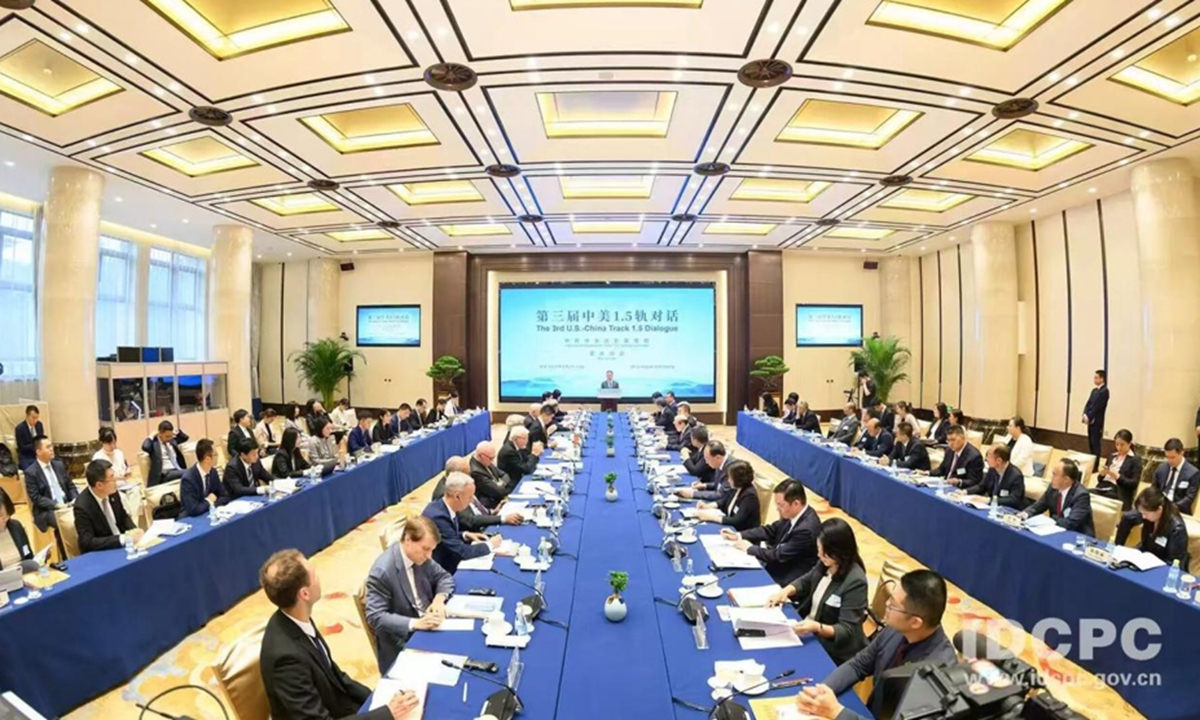
The third China-US Track 1.5 Dialogue was held in Beijing on Tuesday, bringing together government officials, scholars and business representatives from both countries for discussions on constructive strategic stability and practical cooperation.
Co-hosted by the International Department of the Central Committee of the Communist Party of China (IDCPC) and the Asia Society, the dialogue was attended by about 40 representatives. Participants included officials from relevant Chinese government departments and local governments, experts from think tanks and universities, as well as figures from US strategic and business circles, including John L. Thornton, co-chair of the Asia Society Board of Trustees.
Under the theme "Constructive Strategic Stability - Practical China-US Cooperation in the New Era," the participants held candid, in-depth and constructive exchanges, according to the IDCPC's release on its WeChat account on Tuesday.
Addressing the dialogue, Liu Haixing, head of the International Department of the CPC Central Committee, said the two sides have recently followed the direction set by the two heads of state, taken practical steps to strengthen communication and dialogue, advanced a positive agenda and achieved notable results.
Liu called on the two countries to continuously enlarge common interests and make cooperation the anchor of positive stability. He urged the two countries to uphold mutual benefit and reject zero-sum games so that competition remains within bounds, to seek common ground while managing differences, and observe the bottom line of no conflict and no confrontation to achieve lasting peace and stability.
Participants discussed ways to enhance political mutual trust, expand economic and trade cooperation, and explore cooperation in artificial intelligence, science and technology, CCTV News reported.
Established in 2023, the China-US Track 1.5 Dialogue operates between formal government-to-government diplomacy, known as Track 1, and purely nongovernmental exchanges, known as Track 2. The second dialogue was held on June 13, 2024, during which participants held candid, in-depth and constructive exchanges around the theme of "sharing perspectives and finding solutions on key and urgent issues."
As a channel involving both government and nongovernmental participants, the Track 1.5 mechanism can help China and the US communicate more effectively, identify common ground and better understand the consensus reached by the two heads of state, Zhou Mi, a senior research fellow at the Chinese Academy of International Trade and Economic Cooperation, told the Global Times on Tuesday.
It can also help translate the consensus into greater mutual understanding and concrete action, Zhou said.
Discussions on AI at this year's dialogue could help the two sides identify shared interests despite existing frictions and technological challenges, creating opportunities for practical cooperation and laying the groundwork for follow-up efforts, he noted.
Wang Yiwei, a professor at the Renmin University of China's School of International Studies, told the Global Times on Tuesday that the Track 1.5 dialogue serves as a bridge between Track 1 and Track 2, allowing participants to discuss sensitive issues and explore policy space while conveying frontline assessments and feasible proposals to decision-making departments.
Liu outlined practical pathways for China-US cooperation in the new era. First, the two sides should uphold mutual respect, peaceful coexistence and win-win cooperation, steer China-US relations to overcome the "Thucydides Trap," and create a new paradigm of major-country relations.
Second, the two countries should jointly shoulder their responsibilities as major powers, make constructive interaction an important driver of international cooperation, address global challenges together and inject greater stability into the world, Liu noted.
Third, they should expand exchanges and cooperation in trade, public health, agriculture, tourism, people-to-people ties, law enforcement and cooperation between localities, thereby strengthening the resilience of bilateral relations and working toward a better future, Liu said.
Overcoming the "Thucydides Trap" fundamentally rejects the notion that conflict between major powers is inevitable, Wang Yiwei said. It reflects an effort by China and the US to pursue a path different from the historical confrontation between an established power and a rising one.
Such a model does not seek to avoid competition altogether, but to ensure that competition has boundaries, differences remain manageable and cooperation retains sufficient space, Wang Yiwei said.
To put this approach into practice, the two countries should respect each other, avoid crossing red lines concerning core interests and reduce the risk of strategic miscalculation. They should expand areas where their interests converge and establish regular cooperation mechanisms on global issues such as climate change, public health, food security and AI safety, turning shared responsibilities into joint action, he noted.
As the world's two largest economies, China and the US should recognize that many global challenges cannot be effectively addressed without coordination between them, particularly at a time of intensifying competition. Constructive engagement is therefore not a temporary expedient but a long-term responsibility that major countries should undertake for the world, Wang Yiwei said.
The dialogue came a day after China's top political advisor Wang Huning met with US delegates attending the event in Beijing on Monday.
During their meetings, the US side said that the US-China relationship is at a special juncture, adding that the sound rapport between the two heads of state constitutes the most valuable and important part of bilateral ties. The US side agrees that both sides should act on the consensus of building a constructive US-China relationship of strategic stability, advance corporate cooperation, expand people-to-people and cultural exchanges, guard against risks such as those posed by artificial intelligence, and deliver benefits to both countries and the rest of the world, according to Xinhua.
。
Current article:http://9p7.chuandanfozhuanbenglipaicuzi.pics/6tkf9/90vrd1e.html
Published on:12:03:49
下载地址2:点击进入迅雷高速下载 温馨提示:邀请好友一起下,可提高下载速度,若遇无法下载,可另选时间尝试或重装软件!
下载方法:安装软件后,点击即可下载,谢谢大家支持,欢迎每天来!